When you think of the word “Zodiac”. What goes through your mind? Star signs? Greek Gods? RDJ and Jake Gyellenhall staring at clues for 2.5 hours?(A timeless classic by the way)
How about stroke management? You know…head positioning, thrombectomy and a clinical trial so riveting they named it ZODIAC. Just me? Alright then.
But according to this study published in JAMA neurology, the way a patient's head is tilted could be the supernatural force standing between recovery and rapid decline in stroke management.
The study asked a simple question? In patients with large vessel occlusion(LVO) stroke, who are waiting for thrombectomy. Is it better to lie them flat at 0°, or tilt them up to 30°?
Seems like a pedantic little tweak to make, especially for someone who’ll likely die without intervention. But the theory checks out: Gravity helps blood flow to the penumbria(the part of the brain that’s salvageable by thrombectomy) when the head of the bed is at 0°. And if you buy a little more time before shipping them off the theatre, that could be a huge win.
A prospective, randomised control trial was done across several hospitals in the States between 2018 and 2023. They recruited patients over 18 with CT-defined LVOs, with a viable penumbria.
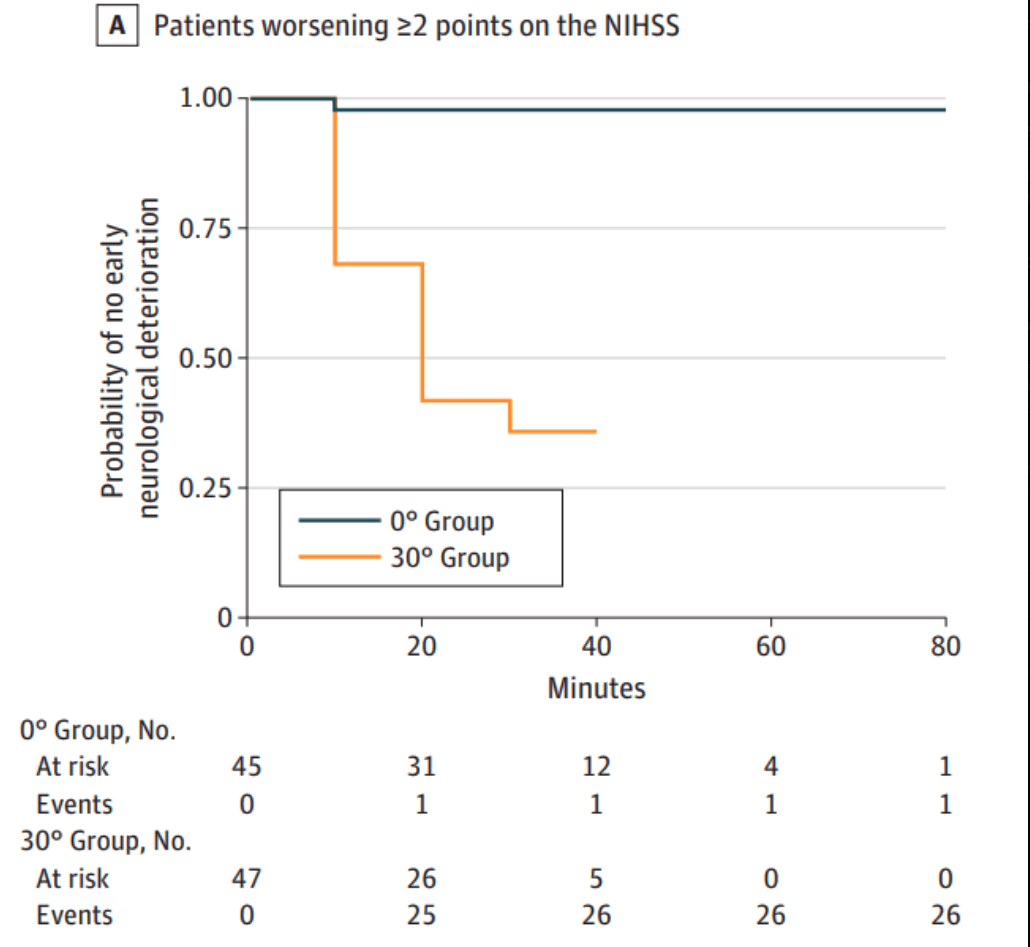
It was a tiny RCT. Just 92 patients were randomised 1:1 to either the 0°(45) or 30°(47) groups. Their position was monitored every 10 minutes until being pushed into the cath lab. And the primary outcome measure was worsening of 2 or more National Institute of Health Stroke Scale(NIHSS) points prior to thrombectomy.
What did they find out?
Clinical Worsening: Only 1 patient in the 0° head position group experienced a worsening of >= 2 NIHSS points compared to 26 patients in the 30° head position group. This led to a Hazard Ratio of a whopping 24.40(95% CI, 4.65-254.37).
Severe Neurological Deterioration: Defined as worsening of NIHSS score of >= 4 points, 1 patient in the 0° group experienced this compared to the 20 in the 30° group
All-Cause Deaths at 3 months: 2 patients(4.4%) in the 0° group died, compared to 10 patients (21.7%) in the 30° group
The results were so stark they stopped the study early due to clear efficacy(hence the small sample size). This means the generalisability of these results are far from being mandated in practice.
In other news, there is a new thrombectomy technique in the woodworks. You compact the clot like rubbish in a landfill then take it out with ease. Check out a video demonstration here