CURB-65.
It's beautifully simple.
Five letters. Five criteria.
In a career full of dumb, convoluted acronyms and funny-sounding drugs, CURB-65 is a breath of fresh air. It's the guideline, AND its letters spell out its criteria.
- Confusion
- Urea >7
- Resp Rate >30
- Blood Pressure <90/65 mmHg
- Age >65
It's oh, so simple. But it hasn't always been...
Before CURB
The year is 2002. But to your respiratory consultant, it is 1 BC. Before CURB.
Patients with pneumonia were arriving in A&E every day with the same question hanging over them. How bad is this infection anyway?
In the years before CURB, we had two main tools to use.
The Pneumonia Severity Index (PSI): A thorough scoring criterion... but it had 20 different variables to plug into to get an answer. Calculating it felt like filling in your tax return before prescribing antibiotics.
The modified British Thoracic Society rule (mBTS): It had just 4 criteria. Confusion, resp rate, diastolic BP, urea >7. But it was too black and white. Score >2 = severe, score <2 = not severe. A very blunt instrument.
So, an opportunity emerged.
Hope for the Goldilocks score.
Granular enough to guide the full range of decisions (home, ward or ICU). But without an onboarding process longer than opening a new bank account.
The Goldilocks score
In 2003, the landmark study was published in Thorax, a BMJ journal.
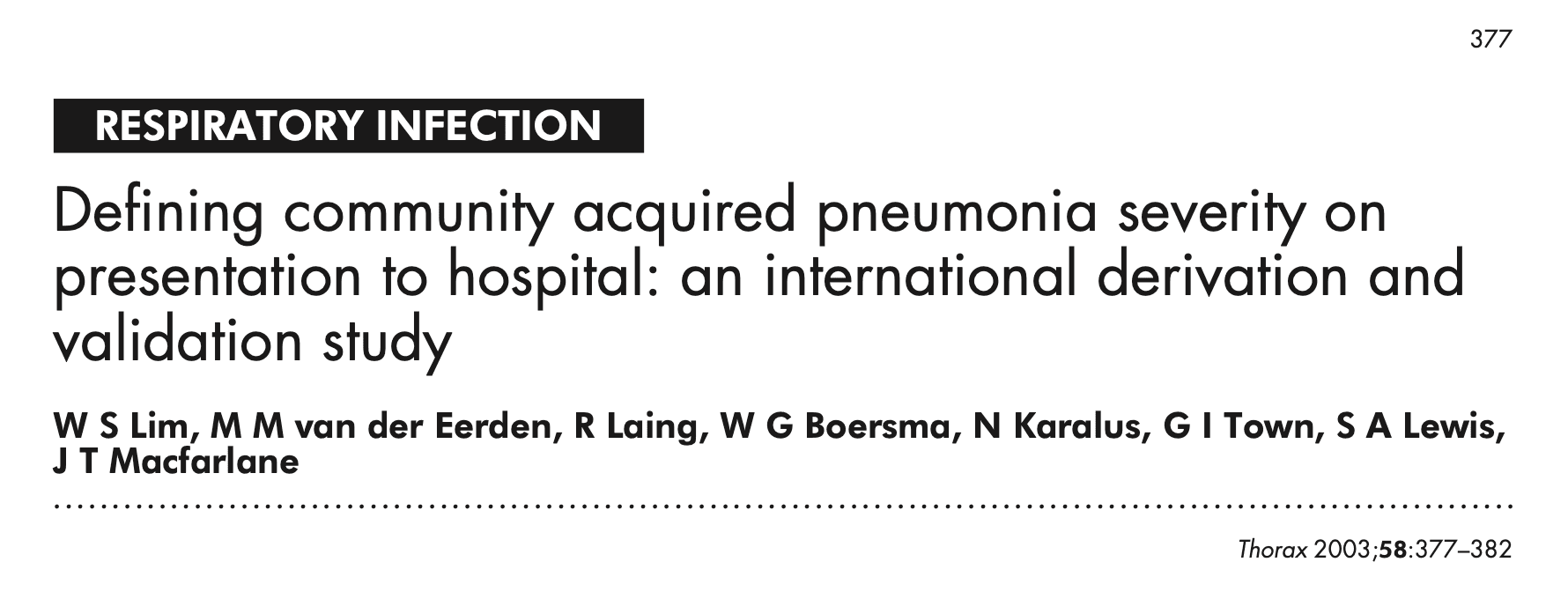
The primary aim was simple: develop a better severity score. Make it practical. Make it sort patients based on mortality risk. Make it work both in hospital and, if possible, community settings.
The hunt for the Goldilocks score begins...
The researchers combined data from three prospective CAP studies in the UK, New Zealand and the Netherlands. Rounding up to a total of 1,068 patients.
Things get a little complex here.
To come up with the Goldilocks score, they first needed to find the relevant criteria. Now comes the detective work.
The researchers threw dozens of variables into a mathematical model and did some statistical wizardry to find out: which of them actually predicted death?
It just so happens the letters that make up CURB were the biggest needle movers in regards to mortality.
They excluded variables like serum albumin - whilst independently associated with mortality, it's not readily available at the time of initial assessment. So they binned it.
They later on included age, as it was just so damn easy to get a hold of.
With that, CURB-65 was born.
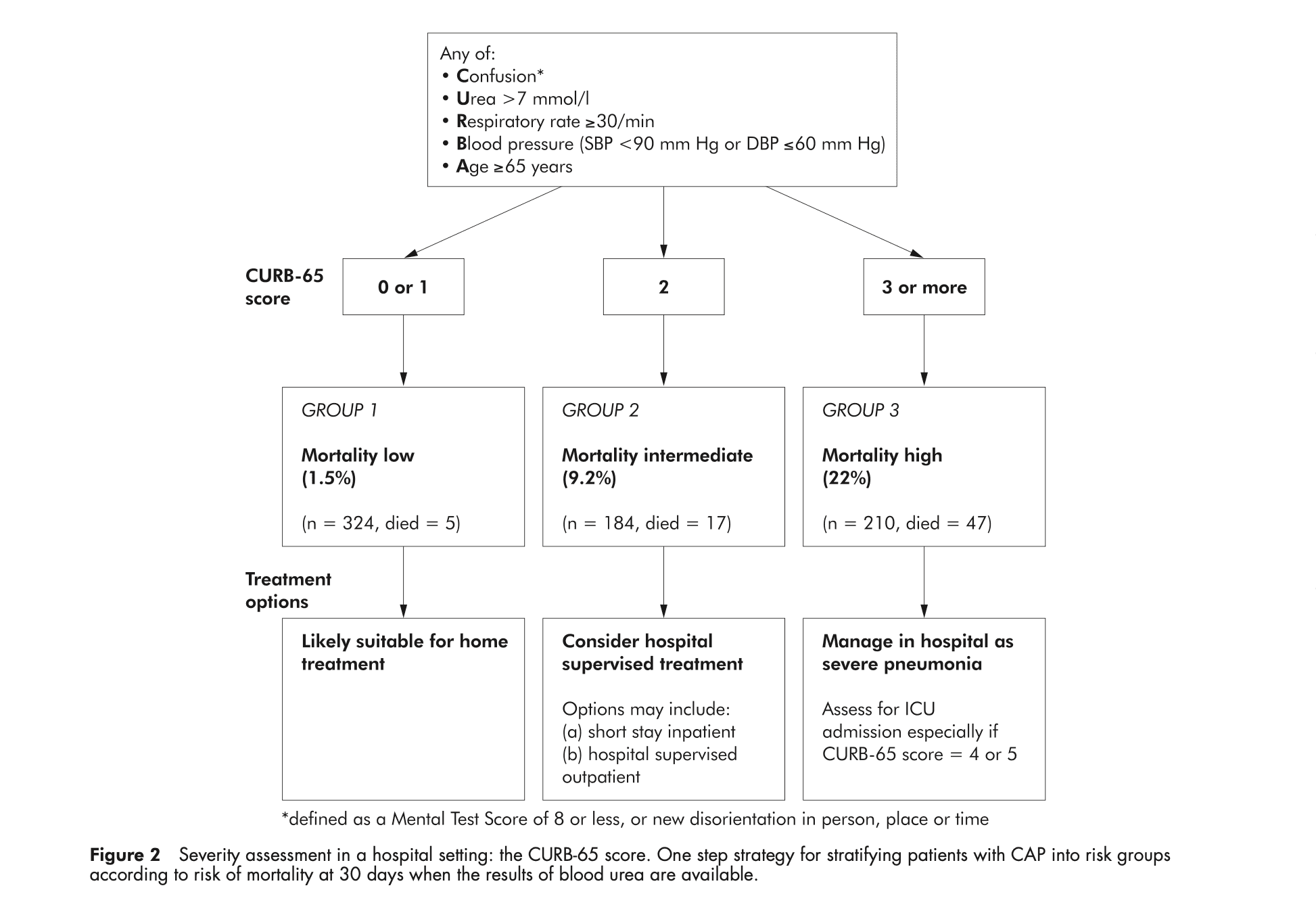
It was made in such a way that each factor was equally weighted. It didn't matter which letter was ticked. As you went from 0 => 1 => 2 => 3 and beyond, your risk of death increased a proportional amount.
Did it actually work?
So the acronym sounds good, n' all, but does it accurately predict severity?
That's where the validation step comes in. Of the 1,086 patients included in the study:
- 80% were used to build CURB-65 (derivation group).
- 20% were used to test if CURB-65 actually worked (validation group).
The validation group supported the trend seen in the derivation group. Mortality rose as CURB-65 increased.
- Score 0: 0 deaths out of 55 patients.
- Score 1: 5 deaths out of 86 patients, about 5.8%.
- Score 2: 8 deaths out of 46 patients, about 17.4%.
- Score 3: 6 deaths out of 23 patients, about 26%.
- Score 4: 1 death out of 4 patients, about 25%.
- Score 5: 1 death out of 3 patients, about 33.3%.
Why it stuck
Now, compared to the old tools:
CURB vs PSI: A systematic review found no significant difference in overall mortality prediction between PSI and CURB-65.
CURB vs mBTS: Roughly a coin flip in raw accuracy, sensitivity and specificity were near identical between the two in the analysis. But CURB wins as it splits results into more buckets and tells you what to do about it. Home, ward or ICU.
Shortly afterwards, CURB-65 spread.
Through BTS guidance. To hospitals around the UK. Then around the world.
And now, more than 20 years later, it's still one of the first scores doctors learn and one of the few scores that actually sticks.