When it comes to matters of the heart, cardiologists are the resident experts.
Equally…
When it comes to matters of the heart, cardiologists are the resident dummies.
You see, CCTing as a heart doctor DOES NOT make you a love doctor, unfortunately.
Our consultant, fresh off his fourth unsuccessful marriage, was inconsolable. At ESC Congress 2026 (Comic-Con for Cardiology), a study was released that hit a little too close to home:
SINGLE-AF.

Let me ask you this. When do we anticoagulate a patient with atrial fibrillation?
Easy - when that CHA2DS2-VASc score is >1 for the XY and >2 for the XX.
Next question… why?
…
Don’t give me the smart arse “bEcaUse NICE sAid sO” answer 😑
Yes, this is another one of those things in medicine. It is the way it is, largely because no one questioned it. According to the study authors, guidelines have been formulated from a hodgepodge of conflicting observational data… which is crazy for such a ubiquitous guideline.
So for the first time, researchers decided to put it to the test with a randomised controlled trial. Think of it like a guideline audit of sorts. Legit checking guidance.
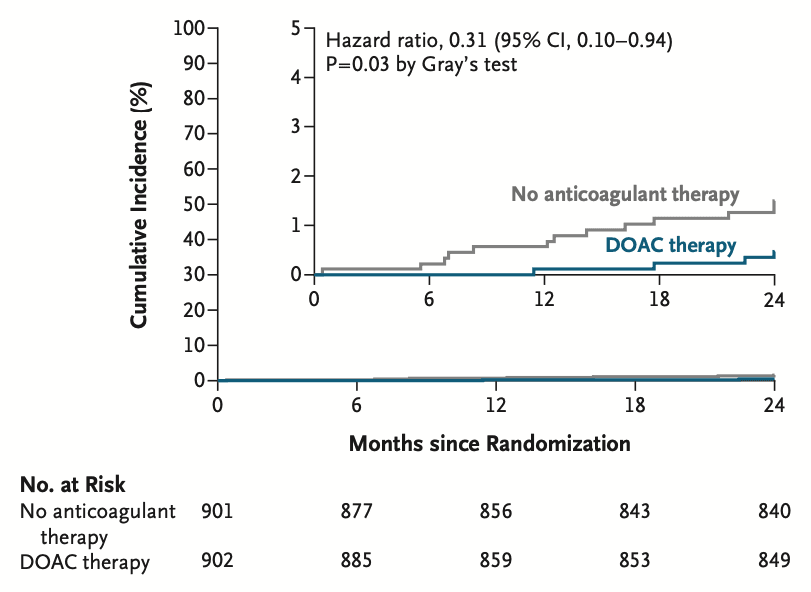
This RCT, published in the NEJM, recruited 1,803 patients across South Korea with AF + a CHA2DS2-VASc score of 1 (men) or 2 (women).
Patients were randomised 1:1 to receive either DOAC therapy or no anticoagulation at all. Then they were scrupulously monitored for 24 months to see which participants had either a stroke, systemic embolism, major bleed or died from CVD events.
Extra points:
- This was an open-label trial - so patients and prescribers knew what they were or were not given.
- It was adjudicator-masked - so the independent committee deciding whether suspected events actually met the definitions for stroke, major bleeding, etc., didn’t know which treatment group the patient was in.
- The DOAC given was either apixaban (5 mg BD) or rivaroxaban (20 mg OD).

And after two years, the results were in: thankfully, for the millions of people already on therapy, DOACs remain on top.
- Primary Endpoint Results: Of the 1,803 patients included, only 17 total events were recorded.
DOAC group: 4/902 (0.5%) vs no anticoagulation: 13/901 (1.5%).
A difference of -1.0% (95% CI -2.0 to -0.1), HR 0.31 (95% CI 0.10-0.94), P=0.03. - Stroke Events Carried: As I said, there were only 17 total events. 13 of them were stroke events. 3 (0.3%) vs 10 (1.1%).
- No Deaths: There were no deaths from a CVD cause in either group, despite being part of the primary composite.
- No Bleeding Difference: Major bleeding: 3 (0.3%) vs 4 (0.5%), HR 0.75 (95% CI 0.17-3.35).
Ultimately, this study confirmed what we already knew. DOACs + intermediate-risk AF is a match made in heaven. Now we finally have an RCT to back it.
At the end of the day, the heart wants what the heart wants.
When in AF, the heart fancies a dinner date with a DOAC.