DING. DING. DING.
Clinicians...
Are.
You.
Ready?
For a fight messier than ward politics...
For a battle bloodier than supratherapeutic INR...
For a tussle rougher than back-to-back night shifts...
For the very first time, two clot-stopping heavyweights step into the ring.
In the blue corner...
It's the darling of the DOAC era...
Apixaban
In the red corner...
It's the dark horse, yet ever effective...
Rivaroxaban
Like all rivalries in the 2020s, the beef was born on Twitter.
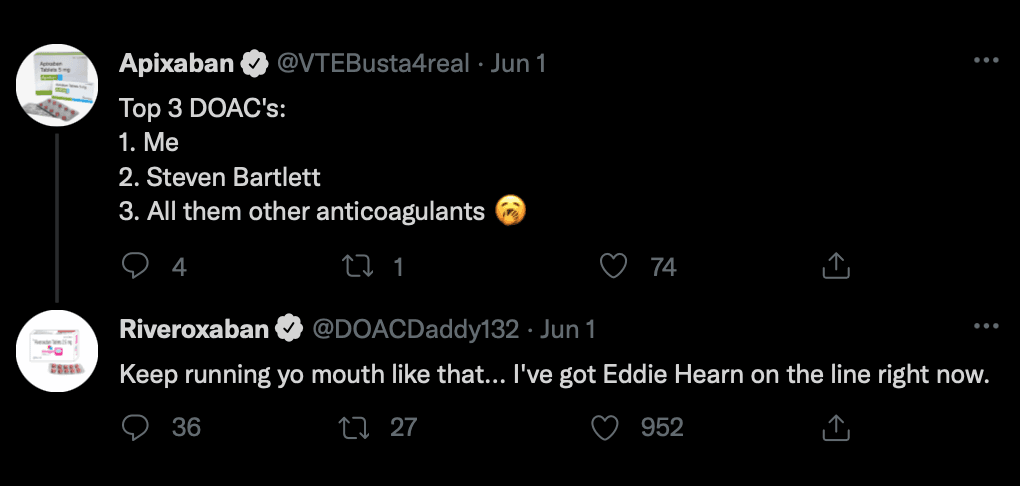
You see, these two DOACs have had issues for years. Both are super effective against VTE and pulmonary embolisms. But there is one stat that has always split the two: who bleeds less?
And the stage was set. The fight was announced for the biggest randomised controlled trial of 2026. Streaming exclusively on pay-per-view via the New England Journal of Medicine.
The COBRRA trial
The COBRRA trial recruited 2,760 adults with symptomatic acute proximal lower-limb DVTs. Then randomised them 1:1 to receive either...
- Apixaban: 10mg twice daily for 7 days, then 5mg twice daily for 3 months.
- Rivaroxaban: 15mg twice daily for 21 days, then 20mg once daily for 3 months.
The primary aim being to determine if apixaban really is superior to rivaroxaban in reducing clinically relevant bleeding during the first 3 months of treatment for VTE.
And after roughing it out for the full 12 rounds, the champion emerged.
And it was the golden boy... Apixaban.
What did they find?
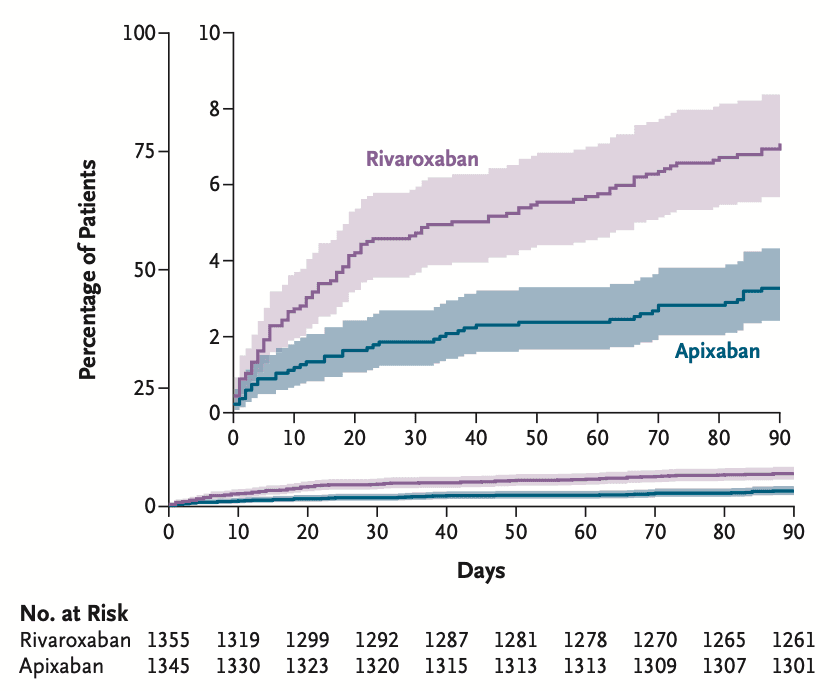
Apixaban caused about half as much clinically relevant bleeding as rivaroxaban over 3 months. Additionally:
- Cases: Apixaban 44/1345 (3.3%) vs Rivaroxaban 96/1355 (7.1%); relative risk 0.46, 95% CI 0.33-0.65; P<0.001.
- Major bleeding was much rarer with apixaban (0.4% vs 2.4%; relative risk 0.16, 95% CI 0.06-0.40).
- Clinically relevant non-major bleeding was also lower with apixaban (2.9% vs 4.9%; relative risk 0.59, 95% CI 0.40-0.86).
- Death was rare, with no clear difference between groups (0.1% vs 0.3%).
- Serious non-bleeding adverse events were about the same, too (2.7% vs 2.2%).
Now, of course, no fight is ever that simple. This was an open-label trial; adherence differed slightly between groups, and patients with cancer or extreme body weight weren't included.
But the conclusion is pretty darn clear. For patients in need of anticoagulation and who are at high bleeding risk, there is an obvious DOAC to go for.