PSHE Didn’t Cover This One: Molly in a Peer-Reviewed Journal⚠️
“DON’T DO DRUGS, KIDS. YOU’LL DIE.”
Ahh yes... The classic nuanced and well-explained proverb universally beloved by PSHE teachers.
Shout it at a bunch of Year 7s, roll the video the week after, and congratulations! You’re now an Ivy-league pastoral teacher.
For many of us, that was the beginning (and end) of our school drug education.
But did it work?🤔
Hard to say, but given that at least 1 in 5 medical students , the curriculum might need more than just a single … line.👀
Still, your teacher wasn’t entirely wrong…these are potent compounds. There’s a reason anaesthetists guard the drug cupboard like the crown jewels.
But what if we could harness their powers for good? Not “my mate Dave swears skunk cured his snoring,” but in proper clinical trials, with dosing schedules, ECG monitoring and more therapist hours than I need after a family holiday.
That’s just what a group of researchers in did. They wanted to see if MDMA could be used to help patients with severe PTSD.
Ideally, the trial would have taken place in the medical tent at Burning Man, but they just couldn’t get the licence agreement in time:
It was a randomised, double-blind trial, where the patients had 3, day-long therapy sessions with a hit of MDMA between them.
The above group was compared to a placebo group only receiving therapy + a placebo.
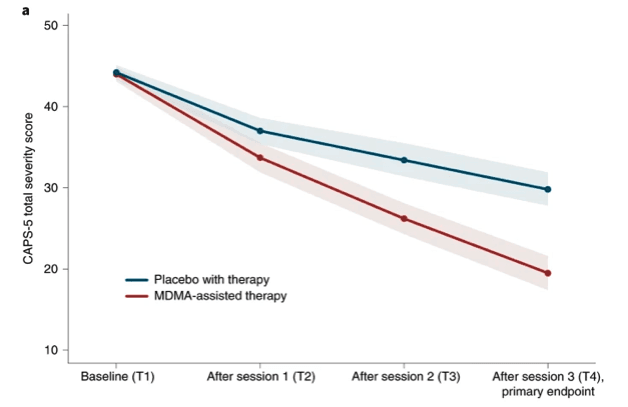
They monitored PTSD symptom severity using the Clinician-Administered PTSD Scale for DSM-5 (CAPS-5).
And the results were actually impressive:
Patients undergoing MDMA plus therapy saw PTSD symptoms decrease significantly vs those on therapy plus placebo.
Mean CAPS-5 scores fell by 24.4 points (s.d. 11.6) in the MDMA group (n=42) versus 13.9 points (s.d. 11.5) in the placebo group (n=37)
But don't get too excited…this isn’t a pill you pop in Berghain before waking in Poland the next day.
There were constant check-ups and participants were very closely monitored 😑. Even then, it wasn’t perfect:
It was a relatively small study, with just 90 participants.
MDMA was only used in conjunction with therapy, so it’s not validated as a standalone treatment.
MDMA( in case you didn’t know) is really trippy. So chances are, some therapists were maybe, just maybe, able to tell when the patient in front of them was high as a kite (thereby ruining the whole ‘double blind’ nature of the trial)
But despite these limitations, it’s a promising professional breakout role for MDMA. From shady warehouse raves to the pages of Nature Medicine … it could be one hell of a glow up.
So if this Class A really does make the leap to ‘BNF-indexed’, it might be time for a slogan update:
“DO DRUGS KIDS!*”
(*as long as you have PTSD, are undergoing concurrent therapy, and have signed away your legal rights as part of a phase 3 clinical trial. The NHS does not claim responsibility for any side effects, including death)