We all know the Heart Failure Formula:
Start with ACE/ARB, add a sprinkle of that Beta-Blocker … any luck? No? Just slap on the others!
Just like hypertension, a slow stepwise approach (🥱) is King in HFrEF.
But…why is that?
Why not just whack it with everything we’ve got?
Well…That’s exactly what’s happened.
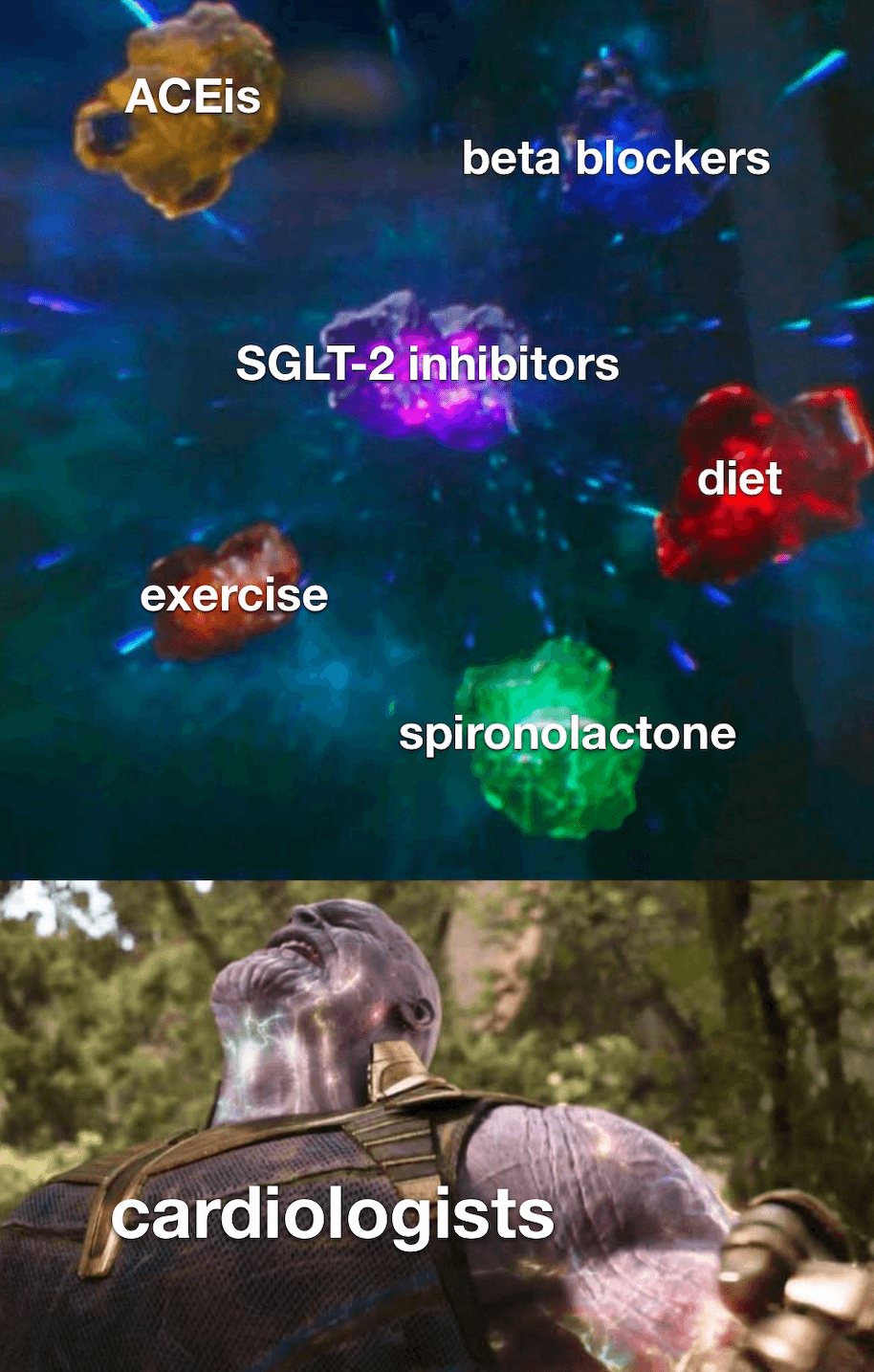
In an Avengers-style move, cardiology has deployed the entire heart failure squad up front:
ACE-inhibitors + Beta-blockers + Spironolactone
And who else?
The most exciting addition is medicine’s new wonder boy, the SGLT-2 inhibitor.
Ignoring that pesky little side effect of your naughty bits necrosing, the -glifolizins are pretty incredible at, well …most things. And HFrEF is no exception.
The and studies, both published in NEJM, examined the effect of dapagliflozin and empagliflozin, respectively, on 8474 participants (with AND without T2DM).
In short:
In DAPA-HF, the proportion of patients with worsening HF (hospitalisation / urgent IV therapy) or CV death was 16.3% vs 21.2%, dapagliflozin vs placebo. (HR 0.74 (95% CI 0.65-0.85) p<0.001)
Plus team dapagliflozin had fewer serious adverse renal events!
Similarly, only 19.4% of those on empagliflozin in EMPEROR suffered CV death or hospitalisation for HF vs 24.7% on placebo (HR 0.75 (95% CI 0.65-0.86) p<0.001)
Not just that, the effect was consistent regardless of diabetes.
AND, it was in addition to standard HFrEF therapy.
And that’s the origin story:
With ACEis (/ARBs) inhibiting RAAS-mediated vasoconstriction, beta blockers calming the chronic sympathetic panic and mineralocorticoid receptor antagonists (ie. spiro) blocking the effects of aldosterone.
Chuck in some SGLT2 osmotic diuresis + decreased preload, and the squad is looking pretty stacked:
And when the evidence was this clear(i.e FDA approved), NICE followed right behind.
In their 2025 review of heart failure medications, they evaluated all of the above to figure out what was most effective in terms of both costs and efficacy.
Surprise, surprise, they also found patients do better when they’re on the Fantastic Four straight away.
Economically speaking, the analysis showed that early combination therapy was both clinically better and cost-effective for the NHS. There’s that money the NHS can’t find for pay restorations…
The science is solid, the economics check out, and the results speak for themselves:
Assemble the Fantastic 4 straight away.
Save some dough.
Protect the heart.