a case for SEPSIS-6 to be SEPSIS-5.2
Subject 3: A Case for SEPSIS-6 to be SEPSIS-
Subject 4:
If medical emergencies were delivery companies, sepsis would be Evri or FedEx.
The second there’s even a hint it might be coming on, you glue yourself to that patient like it’s the last delivery before Christmas. You. Must. Not. Miss it.
One shot is all you’ve got. If you don’t catch it, the patient is gone.
You’ll be left with nothing but a ‘sorry we missed you’ note and a blurry photo of your front porch; the “safe place” they supposedly left it.
Forgive me, I’ve gotten carried away. That delivery man will get his just desserts. I'll make sure of that…
In all seriousness, clinically we do a lot to keep sepsis in check. If there was ever propaganda in medicine, it would be the SEPSIS-6.
Oxygen. Fluids. IV antibiotics. Blood cultures. Lactate. Urine output.
Three in. Three out. Job done. Sepsis solved.
But hold on. Easy tiger. Maybe not so fast with those antibiotics.
Of course, it’s better to be safe than sorry, but what about antibiotic resistance?
Previous studies have reported that 20%–40% of patients treated with antibiotics for suspected sepsis are likely non-bacterial causes.
This paper, published in aimed to not only quantify sepsis antibiotic overtreatment in ED but also assess the possible harms that come with giving it inappropriately.
A retrospective cohort study conducted across 7 US hospitals, reviewed 600 adults treated for suspected sepsis with anti-MRSA and/or antipseudomonal β-lactam antibiotics.
They then had a team of experts(clinical pharmacists, attendings and fellows) retrospectively look over the patient notes and categorise the likelihood of true bacterial infection into:
1. Definite.
2. Probable.
3. Possible but unlikely.
4. Definitely not.
For those with definite or probable bacterial infection, the experts were told to think real hard and consider if a narrower antibiotic would have been sufficient instead.
Here’s the rundown:
Sample Breakdown: Definite = 48%, Probable = 20.5%, Possible = 18.3% and Deffo No = 13.2%
Antibiotic Overtreatment: This means that 1 in 3 (31.5%) patients probably didn’t have bacterial infection. And in those who did, 79.1%(325/411) received antibiotics broader than necessary. Overall 514/600(87.5%) patients were overtreated.
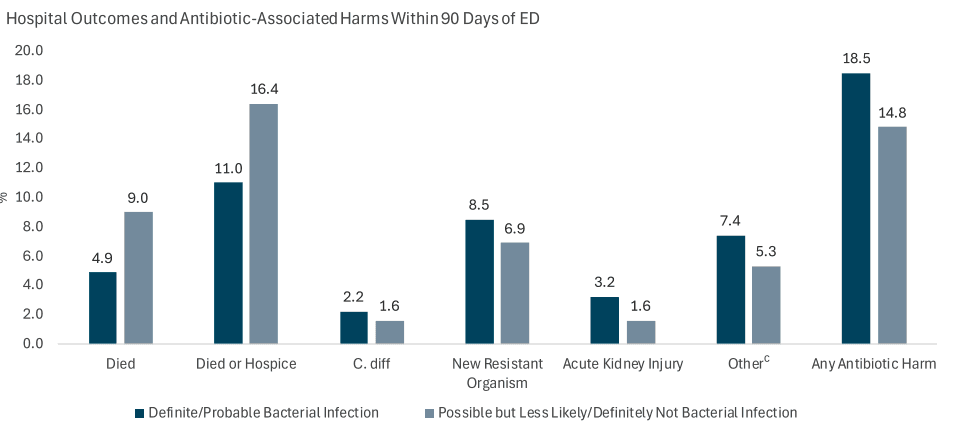
Complications: So 1 in 6 developed antibiotic associated complications with 90 days of Sepsis treatment. The most common being infection/colonisation with resistant organisms(8%)
Mortality: Deaths were significantly higher in patients with unlikely/no infection (9%) vs. those with definite/probable infection (4.9%).
I know, I know, everyone is a genius in hindsight – facing an increasingly hemodynamically unstable patient is very different to reviewing notes on a treated patient. And in the grand scheme of things, this data set is tiny – a larger trial is needed to validate the need for policy change.
But when 87.5% of patients were determined to be overtreated, it might be worth lending it an ear.
[Funny here]