Semaglutide is a global superstar.
From humble beginnings as a fourth-line diabetes medication, the GLP-1 agonist felt her talents going to waste. So she packed her bags and left her small hometown of Diabetesville to chase her big break in Obese-City.
It didn’t take long to attract interest from major agencies like Eli Lilly and Pfizer, but she eventually signed with Novo Nordisk. Deeming her name too ethnic, they gave her a new stage name: Ozempic.
From there, her career took off.
She became the darling of Obese-City. A generational talent in the world of weight loss.
And like all breakout stars, she started landing roles in conditions she had no business in.
Alzheimer’s, addiction, heart disease. Like Brad Pitt playing Malcom X
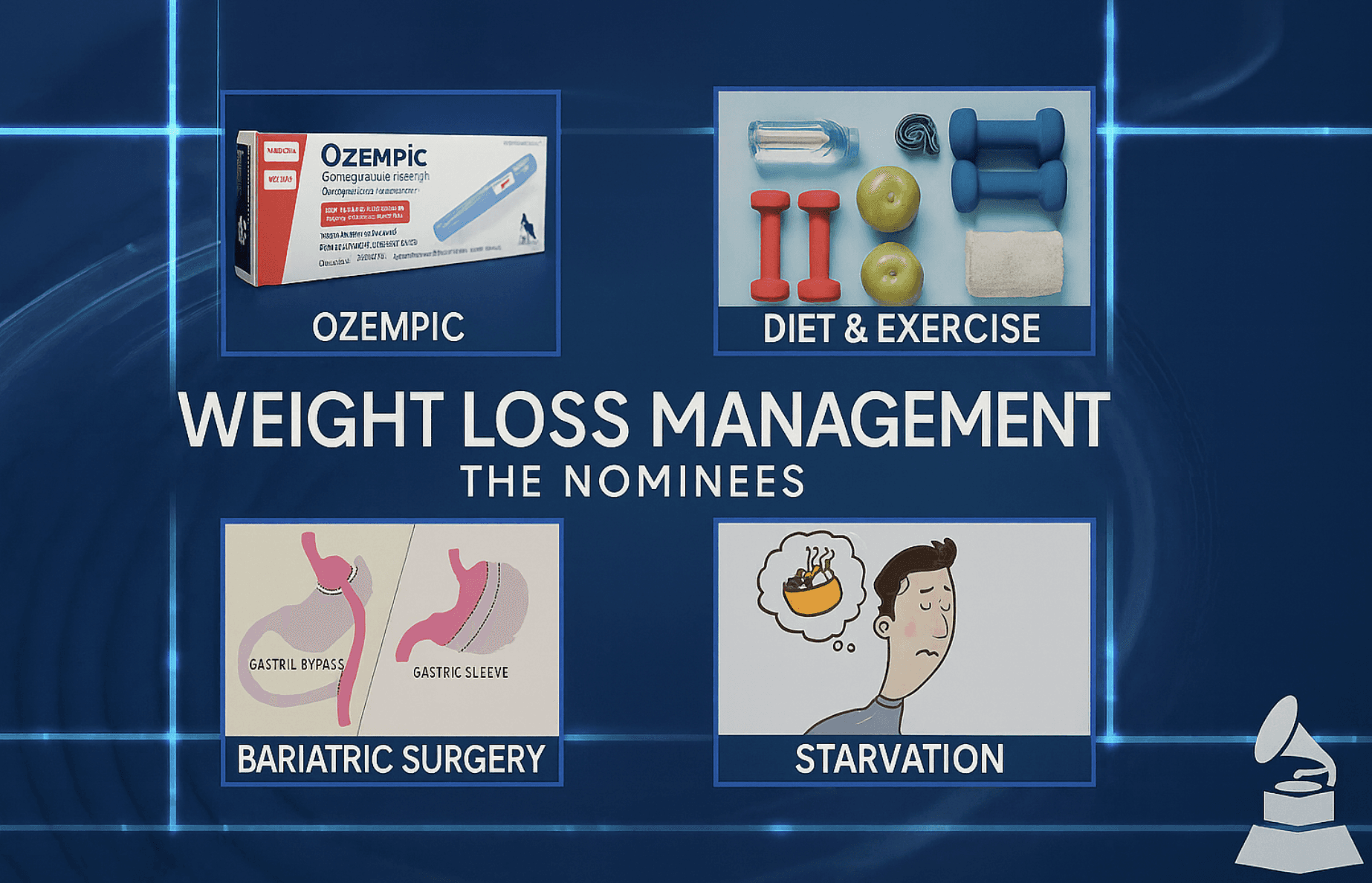
Now she’s up for the big one: Academy Award for Weight Loss Management of the Year.
But standing in her way is an industry veteran.
Winner of the award every year since its birth in 1953…Bariatric Surgery.
Does the rookie have what it takes to dethrone the champ?
This study, published in JAMA Surgery, set out to compare weight loss and long-term cost of metabolic bariatric surgery (MBS) vs GLP-1 receptor agonists (GLP-1 RAs)
This retrospective cohort study was conducted across the USA and recruited over 30,000 US adults with class II and III obesity. Drawing on electronic health records and insurance claims, they took 14,101 MBS patients and 16,357 GLP-1 RA patients. Bariatric methods were gastric sleeve and bypass surgery. GLP-1 RAs included were semaglutide, tirazepatide or liraglutide
The main outcome measures were: Total weight loss, Treatment costs, and Obesity-related comorbidities.
So what did they find?
Weight Loss: Surgery wins here. BMS led to a greater mean weight loss of 28.3% over 2 years vs GLP-1 RAs 10.3%. And in 96% of MBS patients, a >10% weight loss was sustained vs 45.9% in the GLP-1 RA group.
Costs: Bariatric surgery has a mean cost of $51,794 across two years. In that same time period, GLP-1 maintenance came up $63,483. The study found it took just 15 months for GLP-1s to catch up in cost to the surgery.
Health Outcomes: MBS has fewer inpatient stays, outpatient visits and A&E visits + lower rates of comorbidities at follow-up.
So, for another year running, the award goes to bariatric surgery as the most clinically effective and cost-effective weight loss strategy.
Presently, surgery is the last resort therapy for weight loss management. There’s no shock regarding its effectiveness, but its price comparison does come as a surprise.
Ozempic has been snubbed. Surgery is still on top. But with stronger versions coming out every week, who knows what the future holds for GLP-1 RA’s.