In medicine, we have our commandments of unholy combinations.
Somewhere at the top, it is written in the scripture:
💜Bieber, 🧠 Brain Trauma and🥀 Brainrot
💜Bieber, 🧠 Brain Trauma and 🩸 Bleeding Risk
Thou shalt not mix anticoagulants with antiplatelets in stroke patients without AF(NICE 12:6, NKJV)
The prevailing wisdom has always advised against it. The research concurs.
Hell, even a certain unnervingly good newsletter wrote an article about the these drugs almost exactly a year ago.
But as Justin Bieber reminded us all at Coachella this week, you should Never Say Never.
And apparently, neither should clinical researchers…
Published in the , these researchers wanted to challenge the status quo in a way that hadn’t been done before: Looking at a new kind of anticoagulant.
Step aside, apixaban. Not today, dabigatran. Warfarin, please don’t even look our way.
Today, it’s a factor XIa inhibitor called Asundexian to undergo the scrutiny of a randomised control trial.
The logic is simple: research has found that genetically lower levels of Factor XI were linked to a lower ischaemic stroke risk. So… if that's the case, surely if we can reduce Factor XI levels, we can also reduce the risk of additional ischaemic events?
The researchers got to work.
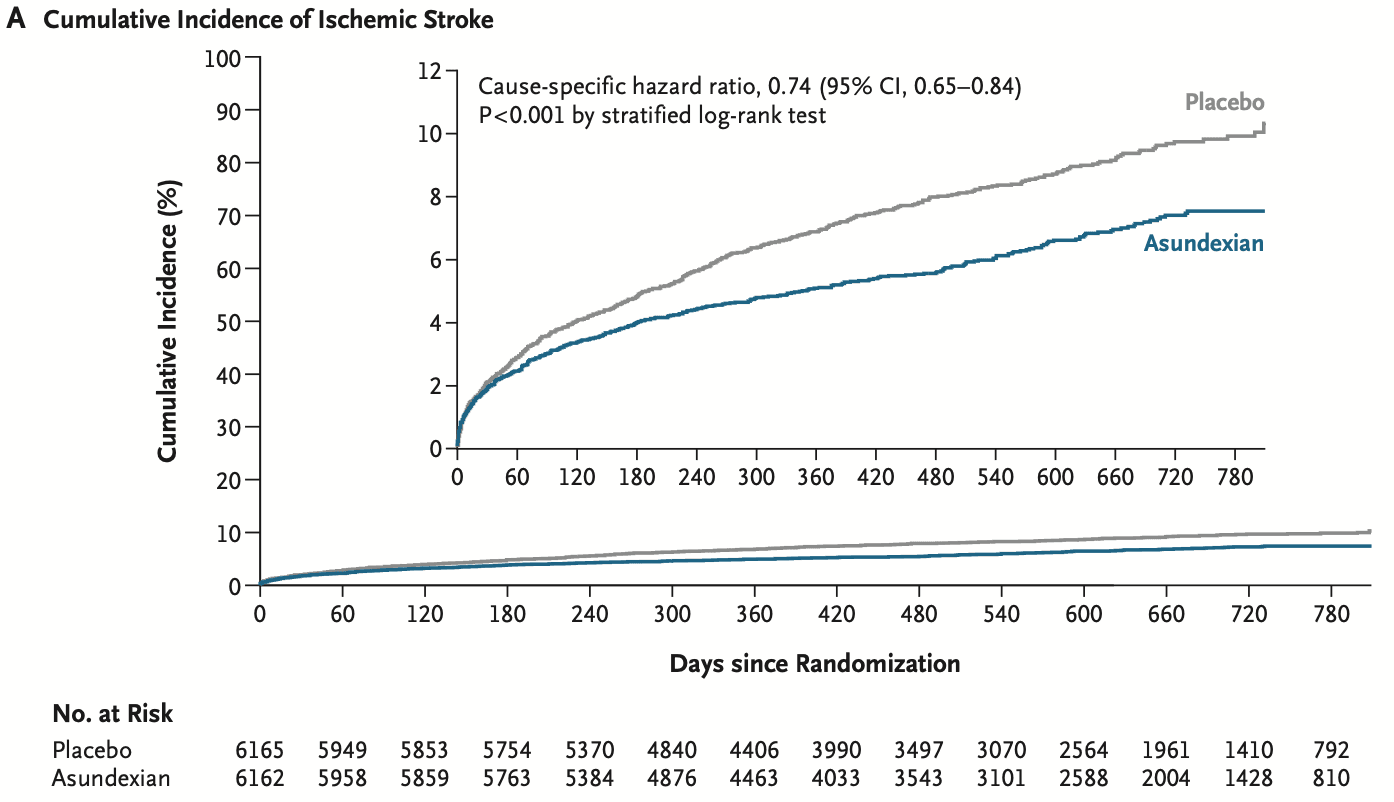
They recruited 12,327 patients across 702 centres in 37 countries. To qualify, patients had to have had a noncardioembolic ischaemic stroke or high-risk TIA within the last 72 hours. They were then randomised 1:1 to either:
Receive Asundexian 50mg + standard antiplatelets(N = 6162)
Receive placebo + standard antiplatelets(N = 6165)
To be taken daily. Then they watched like hawks to see
Did an ischaemic stroke return? (primary efficacy outcome)
Did bleeding get worse? (primary safety outcome)
After waiting patiently for 1.5 years… the marquee findings were this:
The incidence of ischaemic stroke was significantly lower with asundexian than placebo AND the incidence of major bleeding was similar between groups
Ischaemic stroke occurred in 6.2% of the asundexian group vs 8.4% of placebo(95% CI, 0.65-0.84); P<0.001
Major bleeds occurred in 1.9% of the asundexian group vs 1.7% of placebo(95% CI, 0.85-1.44); P = 0.46
Disabling or fatal strokes were also reduced, 2.1% vs 3.0%, hazard ratio 0.69.
Was the trial perfect? They never ever are…
Limitations: The biggest concern is generalisability. The patient population was overwhelmingly mild stroke patients + population diversity that only Tommy Robinson would approve of (2% of participants were black).
Whilst not immediately practising changing and more studies to be done, there is hope yet for an anticoagulant and antiplatelet to live in perfect harmony. Reducing stroke recurrence without increasing bleeding.
So I hope it’s not sacrilegious to say, someday, we may all be beliebers in asundexian.