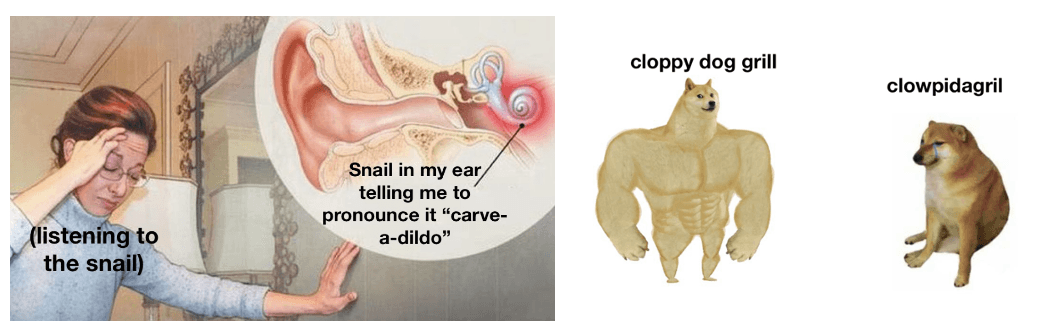
“Err … cloppy-dog-grill?” 🌹
Classic. We’ve all butchered a drug name and felt our clinical cred collapse quicker than a 90 year old’s veins.
Sadly, juniors everywhere suffer from mispronouncitis: a tragic condition characterised by vowel invention and incoherent mumbling when put on the spot.
Leading reports even suggest as many as five medical students per day ask an elderly gentleman if he’s taking his ‘fine-ass-to-ride’ for his BPH
Mispronuncitis has a list of triggers longer than acute pancreatitis. But it's undoubtedly most endemic within those prescribing Monoclonal antibodies – as they’re all just names of IKEA furniture, with -amab slapped onto the end.
Take inebilizumab for example:
Unpronounceable? ✅
Sounds like a hex from Harry Potter? ✅
Worth paying attention to? Definitely, if you want to ✨dazzle✨ the neuro consultants and atone for your pronunciation sins.
But how does it even work?
Inebilizumab targets autoimmune CD19+ B cells. It prevents them attacking the NMJ thus preventing worsening autoimmune myasthenia gravis. Targeting CD19 rather than CD20 means it catches B cells earlier in their development, something not explored before.
Cue the MINT trial, published in the New England Journal of Medicine.
This was a phase 3, double-blind RCT investigating inebilizumab vs placebo for patients with generalised myasthenia gravis. They recruited 238 participants who were either:
Positive for anti-acetylcholine-receptor (AChR) antibodies OR
Anti-muscle-specific tyrosine kinase (MuSK) antibodies.
All participants got doses of inebilizumab (300mg on day 1 and day 15) or placebo. MuSK-positive patients were followed to 26 weeks, (AChR)-positive participants were to 52 weeks
The main outcome was the change in the MG-ADL* score (+ the QMG† score) at week 26 - i.e. did patients’ day-to-day muscle fatigue and weakness improve?
And what did they find
By week 26 the mean change in MG-ADL was -4.2 with inebilizumab vs -2.2 with placebo (adjusted difference -1.9, 95% CI -2.9 to -1.0; P<0.001)
QMG results also scored in favour of inebilizumab: -4.8 vs -2.3 (adjusted difference -2.5, P<0.001)
And despite headaches, coughs and UTIs all noted as side effects, there was no clear difference in serious adverse events.
So at least compared to no treatment, Inebilizumab is pretty convincing 👍
Some caveats: not a huge sample size, long-term safety still TBD and monoclonals come with a price tag that makes Zone 2 London rent look decent.
Plus not every MG patient is AChR/MuSK positive (shoutout to the unlucky seronegatives👋).
That’s said, inebilizumab looks to have a bright future:
Effective, well tolerated, and guaranteed to join the “Drugs I Can’t Pronounce” Hall of Fame, right next to clopidogrel and leve .. leve tira … leve-tira-see-ta.. nah, forget it.
https://x.com/NEJM/status/1965521940602638763
I write about medical research every single week. I do it because I find current outlets kinda dry. Medicine is not. I've been practicing for some months now and I have something I quite enjoy.
I think others do too as over 9000 medics have joined the community. If you haven't, check out