The Early Bird Gets the Worm… and a Lower Risk of Atrial Fib
You Should Probably Ask About Sleep in AF History’s [Latest Research Update]
Look at them all. The morning people. With their chirpy disposition. A Parkrun, morning affirmations and 3 chapters of Atomic Habits, all before 8am.
Those early birds that get the worm. Flexing their “perfect sleep score” on their Whoop or Oura ring. Powered by black coffees and self-satisfaction.
What’s their secret? And where's my worm?!
I know comparison is the thief of joy, but now research verifies what I secretly knew to be true:
If your sleep habits involve staying up past midnight and daytime napping like a Mediterranean pensioner… You might be courting atrial fibrillation.
This was found in research published in the European Journal of Preventive Cardiology. The Spanish researchers set out to investigate the association between daytime napping, night sleeping time and incidence of AF.
To do it, they ran a large prospective cohort study. Over 20,000 university graduates who were AF-free at baseline filled out questionnaires about how long they sleep for and whether they nap.
Daytime naps were grouped into <30 mins/day, ≥30 mins/day, or no nap
Nighttime sleep is categorised as adequate (6–8 hr/day) or inadequate (<6 hr/day or >8hr /day) — because apparently too much sleep is also a problem. Who knew?
With the patience of a Rihanna fan, the researchers followed up for the next 15 years to see who would develop AF.
What they found was that:
Out of the 20,827 people followed, 163 developed confirmed AF
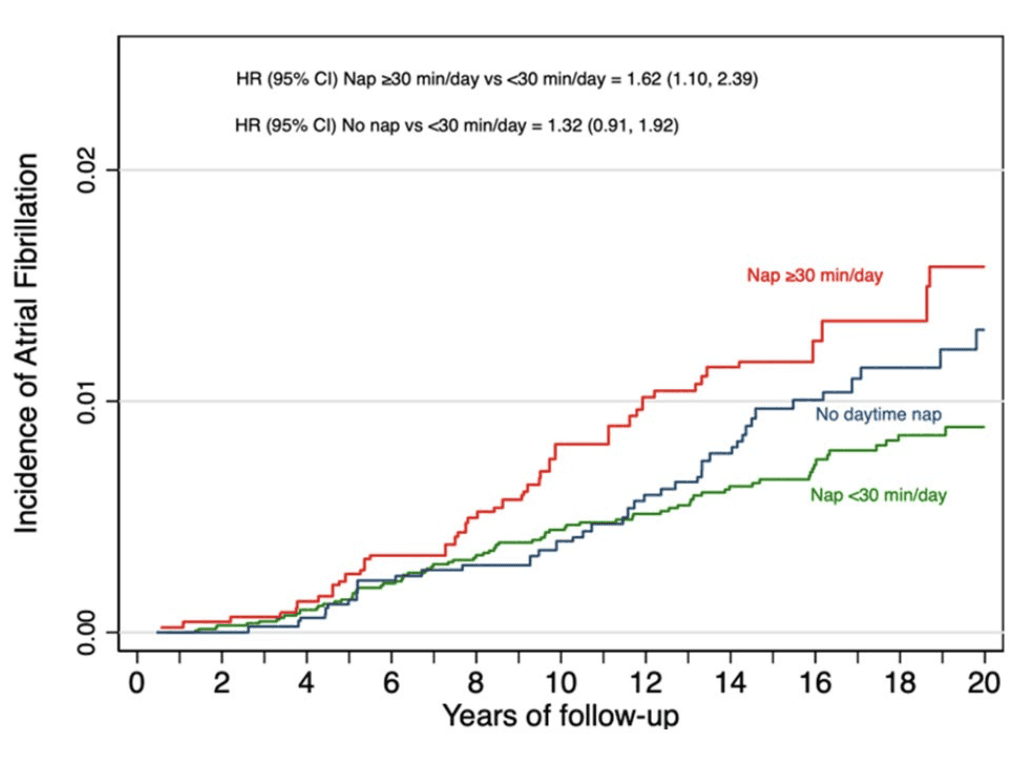
Long naps (≥30 min/day) were associated with a 62% increased risk of AF compared to short naps (<30 min/day) (HR = 1.62; 95% CI: 1.10–2.39).
There was no real difference between short naps and no naps
Inadequate sleep (<6 or >8 hours) raised AF risk too - 89% higher compared to the sweet spot of 6–8 hours (HR = 1.89; 95% CI: 1.10–3.23).
The combination of long naps and inadequate nighttime sleep had the highest risk. A threefold increase in AF (HR = 3.19; 95% CI: 1.30–7.79).
Coffee, alcohol, and now irregular sleep schedule, and even siestas? Managing heart risks has a way of sucking the fun out of life, doesn’t it?
But, like all studies, this one has its limitations. The overall incidence of AF was pretty low, affecting the statistical power. Sleep habits were self reported, and only baseline sleeping and napping patterns were assessed. People can change, y’know.
This study isn’t saying you have to ditch your personality and start doing sunrise yoga in Lululemon.
But when looking at lifestyle factors in patients with cardiovascular risk: it’s worth asking what time they finished that K-drama last night… and just how romantically attached they are to their bed.
https://www.medscape.com/viewarticle/long-daytime-naps-and-less-nighttime-sleep-signal-high-af-2025a1000jqu