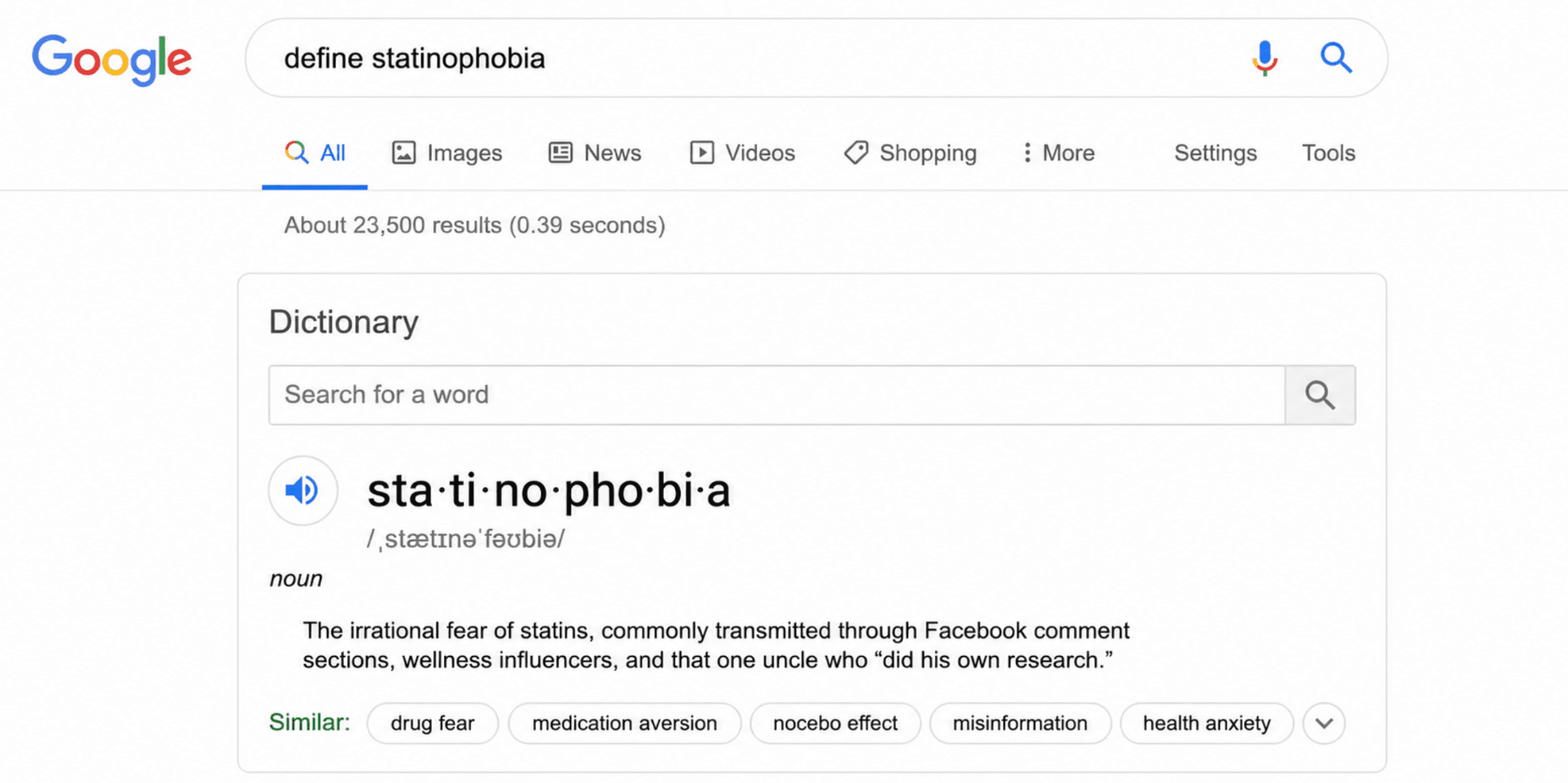
Are you statinophobic?
Statins - the UK’s most commonly prescribed drug, are also the UK’s most controversial drugs. We could go into a whole deep dive on the philosophy of statin hate. Socrates and Plato would have had a field day with it.
However, the standout aversion comes from:
Its prophylactic nature: it doesn’t solve an immediate issue. Ibuprofen for headaches. Antibiotics for infection. Ozempic to lose 10kg. Statins are a silent worker.
Side effects: They have a large, daunting list of side effects. A long, long, long list.
You see, regulation works like this:
Product labels are not a list of proven harms. They are a catalogue of reported or suspected associations. Of which some are well established, and others far more uncertain.
And as a result of being such a mainstream drug, statins have been investigated to death.
Resulting in a large list of “potential” side effects of taking the medication.
Product labels side effects include: memory loss, depression, sleep disturbance, neuropathy, liver dysfunction… in fact, there is a listed 66 “undesirable effects” that statins have warnings against.
And for many patients, that list alone is enough to decline a prescription that might otherwise reduce their risk of a life-threatening cardiovascular event.
So instead of arguing on X, a group of researchers did the unsexy thing and went back to the research:
Published in The Lancet, this meta-analysis asked this:
According only to high-quality evidence, are the side effects listed on statin drug labels actually caused by statins?
To be included in this study, strict inclusion criteria had to be met:
Must be a randomised, double blind control trial
>= 1000 participants in the trial
Control must be either statin vs placebo, or more‑intensive vs less‑intensive statin regimen.
And after whittling down all the evidence, they landed on 19 statin vs placebo trials and 4 more‑intensive vs less‑intensive statin regimen, totalling 154,664 participants in this meta-analysis.
After doing their statistical magic, the headline finding was this:
Out of the 66 “undesirable effects” investigated, there was no convincing evidence of causality found in 62 of them.
Those categories include:
Renal
Neurogical
Liver (clinical)
Respiratory and lung
Erectile/sexual function
Cognition and mental health
In other words, across these categories and more, according to the highest-quality evidence, participants taking statins were no more likely to experience these conditions than those taking a placebo.
The four categories where statins did have an effect were:
Abnormal AST/ALT: Absolute Excess 0.09%
Other Liver Function Abnormalities: Absolute Excess 0.05%
Urinary Composition Alterations: Absolute Excess 0.07%
Oedema: Absolute Excess 0.07%
So even in those where effects were found, they seem to be very marginal.
So yes, statins appear to slightly raise certain liver enzyme levels and cause you to retain more fluid than you normally would.
But they don’t quite cause widespread cognitive collapse, emotional ruin, kidney failure, lung disease, or sexual dysfunction - at least according to 150,000 patients.
Which means if you're going to have a phobia, it probably doesn't need to be statins.
Make it something more sensible.
Like spiders or Michael Jackson.